Vijayanagara Architecture Temples
Vijayanagara architecture of 1336–1565 CE was a notable building idiom that developed during the rule of the imperial Hindu Vijayanagara Empire. The empire ruled South India, from their regal capital at Vijayanagara, on the banks of the Tungabhadra River in modern Karnataka, India. The empire built temples, monuments, palaces and other structures across South India, with a largest concentration in its capital. The monuments in and around Hampi, in the Vijayanagara principality, are listed as a UNESCO World Heritage Site.
In addition to building new temples, the empire added new structures and made modifications to hundreds of temples across South India. Some structures at Vijayanagara are from the pre-Vijayanagara period. The Mahakuta hill temples are from the Western Chalukya era. The region around Hampi had been a popular place of worship for centuries before the Vijayanagara period with earliest records dating from 689 CE when it was known as Pampa Tirtha after the local river God Pampa.
| Temple | Year | Details |
Bala Kini Raghunatha Temple
Bhatkal,Uttara Kannada | 1590 | Built by Bala Kini |
Chandranatha (Jain) Temple
Bhatkal,Uttara Kannada | c.1484 | The temples was built by Hadavalli prince Salvendra |
Khetapai Narayan Temple
Bhatkal,Uttara Kannada | 1540 | Built by local chief Ketapayya |
Shantappa Naika Tirumala Temple
Bhatkal,Uttara Kannada | 1555 | Built by Shantappa Nayaka |
Nandi (Bull) Temple
Bengaluru,Bangalore Urban | c.1509–1529 | |
Chandikeshwara Temple
Hampi, Ballari | c.1545 | UNESCO World heritage site |
Ganagitti Temple
Hampi, Ballari | c.1385 | An inscription on the site states that the temple was built in A.D. 1385 by lruga, in the reign of King Harihara II, UNESCO World heritage site |
Virupaksha Temple
Gokarna,Uttara Kannada | 1570 | Built by Queen Virambika |
Someshwara Temple
Bengaluru,Bangalore Urban | 16th century | One of the oldest temples in Bangalore, major additions or modifications to which were made during the late Vijayanagara Empire period under the rule of Kempe Gowda I (Hiriya Kempe Gowda). |
Achyutaraya Temple
Hampi, Ballari | c.1529-1546 | UNESCO World heritage site |
Alvar group Temple
Hampi, Ballari | c.1556 | Five temples were built for the Vaishnava saints Tirumangai, Mudal, Nammalvar, Tirumalishai & Ramanuja; UNESCO World heritage site |
Badavi linga Temple
Hampi, Ballari | 15th century | UNESCO World heritage site |
Balakrishna Temple
Hampi, Ballari | c.1509-1529 | UNESCO World heritage site |
Chandrashekara Temple
Hampi, Ballari | c.1406-1446 | UNESCO World heritage site |
Hazara Rama Temple
Hampi, Ballari | c.1406-1542 | UNESCO World heritage site |
Kadalekalu Ganesha Temple
Hampi Ballari | 15th century | UNESCO World heritage site |
Kallina Ratha Temple
Hampi, Ballari | c.1529-1546 | UNESCO World heritage site |
Nandi monolith Temple
Hampi, Ballari | 15th century | UNESCO World heritage site |
Prasanna Virupaksha Temple
Hampi, Ballari | c.1509 | UNESCO World heritage site |
Raghunatha Temple
Hampi, Ballari | c.1529-1542 | UNESCO World heritage site |
Sasivekalu Ganesha Temple
Hampi, Ballari | 15th century | UNESCO World heritage site |
Temple tank (Pushkarni) Temple
Hampi, Ballari | 16th century | Stepped temple tank in Hoysala style, UNESCO World heritage site |
Ugra Narasimha Temple
Hampi, Ballari | 15th century | UNESCO World heritage site |
Virupaksha Temple
Hampi, Ballari | 14th-16th centuries | UNESCO World heritage site |
Vitthala Temple
Hampi, Ballari | c.1426-1542 | UNESCO World heritage site |
Shiva Temple
Hemakuta hill, Hampi Ballari | Early 14th century | Hemakuta group of temples, UNESCO World heritage site |
Chaturmukha (Jain) Temple
Karkala,Uttara Kannada | c.1586-1587 | Literally means "four faced" temple. |
Mallikarjuna Temple
Hospet, Ballari | 1406–1422 | Located in Mallapanagudi, close to Hospet |
Vijayendra Temple
Bethamangala,Kolar | 15th century | |
Narayana Temple
Melkote,Mandya | c.1458 | Also known as Cheluva Narayana temple, it was built by the local Vijayanagara chieftain |
Narasimhaswamy Temple
MelkoteMandya | c.15th century | According to historian George Michell, the massive gateway on the hilltop (gopura) is unfinished. |
Virupaksha Temple
Virupakshi,Kolar | 15th century | |
Pattabhirama Temple
Hampi, Ballari | c.1529-1546 | UNESCO World heritage site |
Saavira Kambada Basadi Temple
Mudabidri,Udupi | c.1429–1430 | Known locally as the 1000-pillared temple |
Someshwara Temple
Kolar City,Kolar | Early 14th century | According to the Archaeological Survey of India the temple is assignable to the early Vijayanagara period |
Gangadhareshvara Temple
Shivagange,Bangalore rural | c.1600 | Shivagange was the principal seat of the Gowda rulers, the founders of Bangalore. Portraits of Kempe Gowda I (dated c.1608) and his two brothers are installed in the rock cut chamber of the temple. |
Gavi Gangadhareshvara Temple
Bangalore,Bangalore | c.1600 | The cave temple was built by Kempe Gowda I in the 16th century. |
Gavi Gangadhareshwara Temple
Bengaluru,Bangalore Urban | 16th century | Cave temple and one of the oldest temples in Bangalore, dates from the late Vijayanagara Empire period, built by Kempe Gowda I (Hiriya Kempe Gowda). |
Srikalahasteeswara Temple
Srikalahasti, Andhra Pradesh | 11th century | The inner temple was constructed around 5th century and the outer temple was constructed in the 11th century by the Rajendra Chola I, later Chola kings and the Vijayanagara kings |
Uddhana Virabhadra Temple
Hampi, Ballari | c.1545 | UNESCO World heritage site |
Bahubali monolith (Jain) Temple
Karkala,Uttara Kannada | c.1431-1432 | The monolith of Bahubali here stands twelve and half meters tall. |
Vidyashankara Temple
SringeriChikkamagaluru | 16th century | According to art historian George Michell, the unusual stellate appearance of the temple is due to the influence of Hoysala architecture. |
Vishnu Temple
Hampi, Ballari | 16th century | UNESCO World heritage site |
Aghoreshwara Temple
Ikkeri,Shimoga | Late 16th century | The Aghoreshwara shrine was built by Dodda Sankanna Nayaka (or Sankanna I, r.1566–1570) who moved his capital from Keladi to Ikkeri. |
Ananthasayana Temple
Ananthasayanagudi, Ballari | c.1524 | |
Aryadurga Temple
Ankola,Uttara Kannada | 1505 | |
Bahubali monolith (Jain) Temple
Venur,Uttara Kannada | c.1606 | The monolith was built by the local Ajila Chiefs. |
Balarama Temple
Malpe,Dakshina Kannada | 16th century | |
Bhoga Nandishwara[1] Temple
Nandi,Chikkaballapura | 15th century | A pavilion with elegant pillars between the two major shrines, a navaranga mantapa (pavilion) with Yali pillars and a large stepped temple tank (kalyani or pushkarni) were added in this period. |
Gangadhareshwara Temple, Shivagange Temple
Shivagange,Bangalore Rural | 16th century | Cave temple, dates from the late Vijayanagara Empire period, built by Kempe Gowda I (Hiriya Kempe Gowda). |
Gaurishvara Temple
Yelandur,Chamarajanagar | c.1500 | The temple was constructed by a local chief Singedepa Devabhupala of the Hadinadu chiefdom, a feudatory of the 16th century Vijayanagara Empire |
Gopala Krishnaswami Temple
Thimmalapura, Ballari | c.1539 | |
Gunja Narasimhaswamy Temple
Tirumakudal Narasipur,Mysore | 16th century | The temple was under the patronage of the local governor of Mysore, during the Vijayanagara rule over South India. |
Indrani Temple
Manipal,Dakshina Kannada | 16th century | |
Ishwara Temple
Baindur,Udupi | 16th century | |
Jambunatheshwara Temple
Hospet, Ballari | c.1500 | |
Kanakachalapathi Temple
Kanakagiri,Koppal | c.1509–1529 | |
Kollur Mookambika Temple
Kollur,Udupi | c.1616 | Built by Venkatappa Nayaka of the Nayaka Dynasty of Keladi |
Lakshmikanthaswamy Temple
Tumkur,Tumkur | c.1560 | |
Mahaganapati Mahamaya Temple
Shirali,Uttara Kannada | 1560 | |
Mahaganapati Temple
Kurudumale,Kolar | 16th century | |
Mahalasa Narayan Temple
Kumta,Uttara Kannada | 1560 | |
Mallikarjuna Temple
Srisailam, Andhra Pradesh | | |
Partakali Jivottam Temple
Gokarna,Uttara Kannada | 1560 | |
Parshwanatha Basadi (Jain) Temple
Gerusoppa,Uttara Kannada | 1581 | The Basadi is also called Ratnatraya Badasi and was built by Rangapparajodeya. It has shrines for Neminatha, Parsvanatha and Vardhamana. |
Rameshwara Temple
Keladi,Shimoga | Early 16th century | The Rameshvara shrine was built by Chudappa Nayaka (c.1499–1530), the founder of the dynasty, and the adjoining Veerabhadra shrine was built by his successor Sadashiva Nayaka (r.1530–1566). |
Ranganatha Temple
Magadi,Ramanagara | c.1524 | The gopura (tower) were built by the Vijayanagar emperor Krishnadevaraya in the 16th century and was later renovated by King Jayachamaraja Wodeyar of the Mysore Kingdom. |
Ranganatha Temple
Rangasthala,Chikkaballapura | c.1600 | |
Shiva Temple
Thimmalapura, Ballari | c.1539 | |
Someshwara Temple
Magadi,Ramanagara | c.1569 | Built by Kempe Gowda I, the founder of Bangalore |
Sri Chintala Venkataramana Temple
Tadipatri, Anantapur, Andhra Pradesh | 16th Century | The temple was built by Pemmasani Timmanayudu II of the Pemmasani Nayaks. The temple is known for its granite sculptures and is classified as one of the Monuments of National Importance by Archaeological Survey of India (ASI). |
Srirangam / Thiruvarangam
Tiruchirappalli, Tamil Nadu | | Considered as the first among the 108 Divya Desams, Srirangam is home to a significant population of Sri Vaishnavites |
Teru Malleshwara Temple
Hiriyur,Chitradurga | c.1466 | |
Upper Narasimha Temple and Lower Narasimha Temple
Ahobilam, Andhra Pradesh | | |
Veera Bhadra Temple
Lepakshi, Andhra Pradesh | 16th century | The temple was built in 1530 AD by Virupanna Nayaka and Viranna , both brothers who were Governors under the Vijayanagar Empire during the reign of King Achutaraya, at Penukonda who were native to karnataka |
Venkateswara Temple
Tirupati, Chittoor, Andhra Pradesh | 300 CE | Constructed in Dravidian architecture |
Vijayanarayana Temple
Gundlupet,Chamarajanagar | 15th century | |
Vijayaraghava Permal temple
Thiruppukuzhi, Kanchipuram, Tamil Nadu | 13th Century AD | It is counted as one among the 108 Divya Desams dedicated to Vishnu. The temple is revered in Nalayira Divya Prabandham, the 7th–9th century Vaishnava canon, by Thirumangai Azhwar in one hymn. |
UNESCO World Heritage Sites in Karnataka
Vijayanagara Empire
Vijayanagar Architecture
The Vijayanagar kingdom was founded by two brothers Harhara and Bukka who were captured by the Emperor of Delhi, Muhammad bin Tughlaq and forcibly converted to Islam but later escaped and renounced their new faith and launched a crusade against the Muslim invaders. In 1336, they founded the city of Vijayanagar on the banks of the Tungabhadra which they made their capital and undertook repeated campaigns against the northern invaders. The campaigns eventually culminated in the overwhelming defeat of the forces of the Delhi Sultanate and restoration of Hindu rule in South India.
Vijayanagar architecture is a beautiful combination of Chola, Pandya, Hoysala, and Chalukya styles. All these styles had evolved centuries before the Vijayanagar Empire and continued to have its impact on the Empire. Hard granite, which was locally available, was usually the material of choice due to its durability. However, the use of soapstone was also seen in the sculptures and reliefs because it was easy to carve due to its softness.
Sculpture was integrally linked with architecture in the creation of Vijayanagar temples. Large life-size figures of men, women, gods, and goddesses adorn the gopuram of many Vijayagara temples. Temple pillars often have engravings of charging horses or hippogryphs (yali)—horses standing on hind legs with their fore legs lifted and riders on their backs. The horses on some pillars stand seven to eight feet tall. On the other side of the pillar are often carvings from Hindu mythology.
Another element of the Vijayanagar style is the carving and consecration of large monolithic statues, such as the Sasivekalu Ganesha and Kadalekalu Ganesha at Hampi; the Gommateshvara (Bahubali) monoliths in Karkala and Venur; and the Nandi bull in Lepakshi. Examples of this style can also be seen in the Vijayanagara temples of Kolar, Kanakagiri, Shringeri and other towns of Karnataka; the temples of Tadpatri, Lepakshi, Ahobilam, Tirumala Venkateswara, and Srikalahasti in Andhra Pradesh; and the temples of Vellore, Kumbakonam, Kanchi, and Srirangam in Tamil Nadu.
The temples had enclosures adorned with decorative pillars called ‘kalyanamandapa’. There were towers at the entrance, called ‘rayagopurams,’ which were made with brick, stucco, and wood, like the Cholas. Life-sized figurines of gods were common in each of the temples. The temple architecture was also known for having carved pillars with engravings of Yali (hippogryphs) or charging horses. Some pillars have horse engravings that were over seven feet tall. The horses were always depicted with riders on their back.
The palaces usually faced north or east. They were situated in compounds that had high earthen or stone walls. They had raised granite platforms beneath them with layers of moldings adorned by carved bands. The courtly architecture of the Empire was usually made from mortar and stone rubble. It showed influences of Islamic style with its vaults, domes, and arches. The elephant stables, watch towers, and Lotus Mahal palace offer the best examples of this.
There were shrines made especially for Alwar and Vaishnava saints. They were architecturally different in the sense that these had an image of the saint in whose name it was built. These shrines had an enclosure, a separate kitchen, and a feeding hall for the pilgrims. Royal centers had tanks with stepwells called 'pushkarni'. The steps on all four sides had finished schist chloride slabs put in a symmetrical manner to form the structure.
The extension of the Vijayanagar Empire into the Tamil country began with the southern inroads made by Sangama kings between 1356 and 1378. With the destruction of the Madurai Sultanate in 1377-78, most of the present-day Tamil Nadu, eventually, came under the rule of the Vijayanagar Empire. The rule of the Vijayanagar kings was characterized by the restoration of religious freedom to the Hindu majority which was denied by the Madurai sultans and a revival of music, arts and crafts. The rule of the Vijayanagar kings also witnessed the steady decline of Tamil language as the new rulers patronized Kannada and Telugu over Tamil. The Vijayanagar Empire's hold over the Tamil country collapsed in the mid 16th century as the kingdom itself disintegrated into a number of petty chieftainships.
Madura style is the last phase of the Vijayanagar Empire. It continued flourish even after the Empire perished. The most notable specimens of this form can be seen at Ramesvaram, Madura, Tiruvalur, Tinnevelly, Chidambaram, and several other places in the extreme southern parts of India.
Vijayanagar Painting
In addition to architecture and sculpture, the Vijayanagar emperors were enthusiastic patrons of painting. The Vijayanagar school of painting was renowned for its frescoes of Hindu mythological themes on temple walls and ceilings. The rulers of Vijayanagar encouraged literature, art, architecture, religious, and philosophical discussions. With the fall of the Vijayanagar empire after the Battle of Talikota in 1565 CE, the artists who were under royal patronage migrated to various other places such as Mysore, Tanjore, and Surpur.
Absorbing the local artistic traditions and customs, the Vijayanagar school of painting gradually evolved into many styles of painting in South India, including the Mysore and Tanjore schools of painting. Mysore painting, an important form of South Indian classical painting, developed out of Vijayanagar painting and originated in the southern town of Mysore, in Karnataka, during the reign of the Vijayanagar emperors.
Mysore paintings are known for their elegance, muted colors, and attention to detail. Popular themes include Hindu gods and goddesses and scenes from Hindu mythology. The paintings are characterized by delicate lines, intricate brush strokes, graceful delineation of figures, and the discreet use of bright vegetable colors and lustrous gold leaf. More than mere decorative pieces, the paintings are designed to inspire feelings of devotion and humility in the viewer . The painter’s individual skill in giving expression to various emotions is therefore of paramount importance to this style of painting.
The ancient painters in Mysore prepared their own materials. The colors were from natural sources of vegetable, mineral, leaves, stones, and flowers. Brushes were made with squirrel hairs for delicate work, and for superfine lines, a brush made of pointed blades of a special variety of grass was used. Due to the long lasting quality of the earth and vegetable colors used, the original Mysore paintings still retain their freshness and luster even today.
Popular Vijayanagara Temples in Hampi
Some of the popular temples in Hampi that were constructed by Vijayanagara Empire are
- Vijaya Vittala Temple
- Virupaksha Temple
- Achyutaraya Temple
- Badavi Linga Temple
- Lakshmi Narasimha Temple
- Hazara Rama Temple
- Bala Krishna Temple
- Kadalekalu Ganesha Temple
- Underground Shiva Temple
- Hanuman Temple Hampi
- Ganigitti Jain Temple
- Malyavanta Raghunatha Swamy Temple
1. Vijaya Vittala Temple
Vijaya Vittala temple located in Hampi is a classic example of splendid architecture and design. The temple design comprises of temple complex with pillared pavilions within pillared pavilions. Vijaya Vittala Temple which dates back to the 15th and 16th centuries, is dedicated to Lord Vishnu. The temple houses a famous stone chariot which is actually said to be a shrine of Garuda, vehicle of Lord Vishnu.

Vijaya Vittala Temple at Hampi
2. Virupaksha Temple
Virupaksha temple is said to be the crowning glory of India's one of the most illustrious empires, Vijayanagar Empire. The temple was possibly constructed during 9th and 10th centuries. The temple is dedicated to Lord Virupaksha, a form of Lord Shiva who is also the presiding deity of the temple. Apart from Lord Virupaksha, the temple also houses idols of Goddess Pampa, Goddess of River Tungabhadra. The temple festivals are celebrated in the month of February and December.
UNESCO World Heritage Sites in Karnataka
3. Achyutaraya Temple
Achyutaraya temple is located between Gandhamadana and Matanga hills and was built in 1534 AD by Achyuta Deva Raya of Vijayanagar Dynast. The temple was constructed in classic Vijayanagar architecture style and design and is dedicated to Lord Venkateswara. Though much of the temple is in ruins, it is still well known for its grand splendor. The temple also houses a shrine dedicated to Garuda, the Eagle God.
4. Badavi Linga Temple
Badavi Linga temple is a monolithic marvel of Hampi which houses a 3 meter tall Shiva lingam curved out of a single rock. The temple has a stoned sanctum with an open roof while the base of the lingam remains submerged in water. The temple according to locals is said to be constructed during the reign of Vijayanagar rulers. The chamber of the temple fascinatingly remains filled with water always.
5. Lakshmi Narasimha Temple
Lakshmi Narasimha temple houses the stone idol of Lord Narasimha, one of the ten avatars of Lord Vishnu. The temple was constructed in 1528 AD during the reign of King Krishnadevaraya. The temple originally had an idol of Goddess Lakshmi seated on Lord Narasimha's lap but after a raid 1565, Lakshmi's idol was vandalized and removed. Thus, the idol of Lord Narasimha since then is known as Ugra Narasimha which is the most terrifying form in the absence of Goddess Lakshmi.
6. Hazara Rama Temple
Hazara Rama temple is located in the vicinity of the ancient Vijayanagar Empire and is said that it was considered as a private temple by the kings and royalties of the empire. The epic saga of the Ramayana is carved on the walls of the temple in form of characters, stories, events, acts and scenes.
7. Bala Krishna Temple
Bala Krishna temple was built in 1513 AD to celebrate and mark the victory of King Krishnadevaraya's victory over Udayagiri. The temple is dedicated to Lord Krishna in his adored infant form, Balakrishna or Gopalji. The temple’s idol has now been shifted to the State Museum of Chennai. The walls, pillars and domes of the temple is exquisitely carved with depictions from Bhagavata, Lord Krishna’s puranic story.
8. Kadalekalu Ganesha Temple
Kadalekalu Ganesha temple is another monolithic wonder of Hampi. The temple is dedicated to Kadalekalu Ganesha and has a monolithic idol of Lord Ganesha which is 4.5 meters tall. The pillars of the temple are engraved with mythological characters and stories. To the south of the Kadalekalu Ganesha temple, a small shrine is dedicated to Sasivekalu Ganesha which is also carved out of a single stone.
9. Underground Shiva Temple
Shiva temple located in Hampi is built several meters below ground level and is possibly one of the oldest temples located in the city. The temple remains flooded most of the year especially during the monsoons when the chambers becomes completely inaccessible. The inner sanctum of the temple used to have an idol of Lord Shiva but presently, only the pedestal remains.
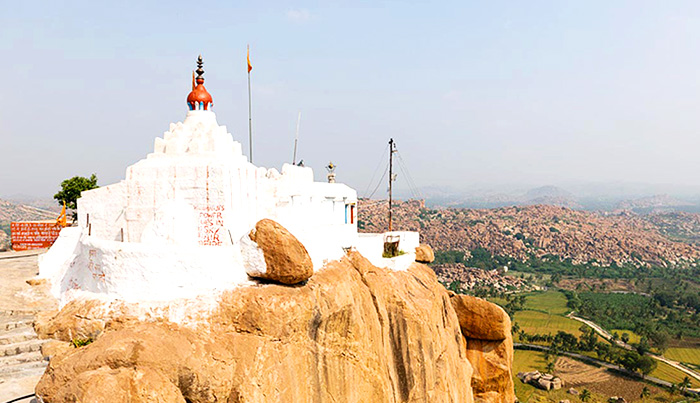
10. Hanuman Temple Hampi
This temple is located on a hillock called the Anjaneya Hill, which is supposed to the birth place of Lord Hanuman. Thetre are about 570 steps to reach to the top of the temple where one finds a huge idol of Lord Hanuman. There are also floating stones for visitor’s view, which are brought from the famed Rama Setu. This temple offers a scenic panaromic view to those who visit the temple.
11. Ganigitti Jain Temple
The Ganigitti Jain temple was built in 1386 A.D. and is dedicated to Kunthunatha, who is the 17th Tirthankara. This beautiful temple was built by Iruga, who was the chief commander during the rule of Harihara II. The lamp post installed infront of the main sanctum bears the inscriptions of the history of the temple. This temple is constructed in true Vijayanagara style, but one also finds the influence of the Chalukyan empire.
12. Malyavanta Raghunatha Swamy Temple
This temple, although not as popular as the rest of the temples in Hampi is a beautiful site to visit. Located at a distance of 3km from the main market street of Hampi, the temple is dedicated to the worship of Lord Rama in the form of Malyavanta Raghunatha Swamy. It is told that the temple is the same location where Lord Rama and his brother Lakshmana resided during their expedition to find Sita.
Huvina Hadagali
Hoovina Hadagali, also known as Huvina Hadagali, represents a town and a taluk situated within the Vijayanagara district of Karnataka.
Puvina Posavadangile
An inscription discovered on a slab placed at the western entrance of the Keshavaswami temple in Huvina Hadagali recounts that "Rebbaladevi, the spouse of the valiant Brahman commander Ravideva or Raviga, undertook the construction of the Kesavadeva temple in Puvina-Posavadangile. This location held special significance as her birthplace. After consecrating the deity in the temple, she generously endowed various parcels of land to support the deity's service. These endowments included provisions for maintaining a nourishment facility for Brahmins, establishing a flower garden, and constructing a dwelling for the satra. These acts were carried out in the presence of the prominent Brahman Mahajanas of the locality.
Puvina Padangile
An inscription uncovered on a stone slab placed at the forefront of the Anjaneya temple in Yenigi, Hadagali Taluk, documents that "during the period when the monarch (Sevuna Yadava king Kandharadeva or Kannara, reigning from 1247 to 1261) was encamped at the nelevidu of Devagiri, the esteemed 120 Brahman Mahajanas from Puvina-Padangile, renowned for their profound knowledge in the Vedas and Shastras, their observance of Aupasana and Agnihotra rituals, and characterized metaphorically as both annihilators of foes akin to elephants in a forest of plantain-trees, and as unyielding shelter, likened to mail-armour, for those seeking refuge, generously donated diverse parcels of land with designated boundaries. These endowments were dedicated to the service of the deity Kusmanatha within the village." Puvina-Padangile's geographical location is noted to be "situated in the Kogali-nadu, serving as the focal point of Nolambavadi-nadu, which, in turn, can be likened to the nose of Kuntala-desa.".
|
|
|
|
|
|
|
|
|
|
|
|
|
|
|
............................. Advertisement .............................
|
|
|
